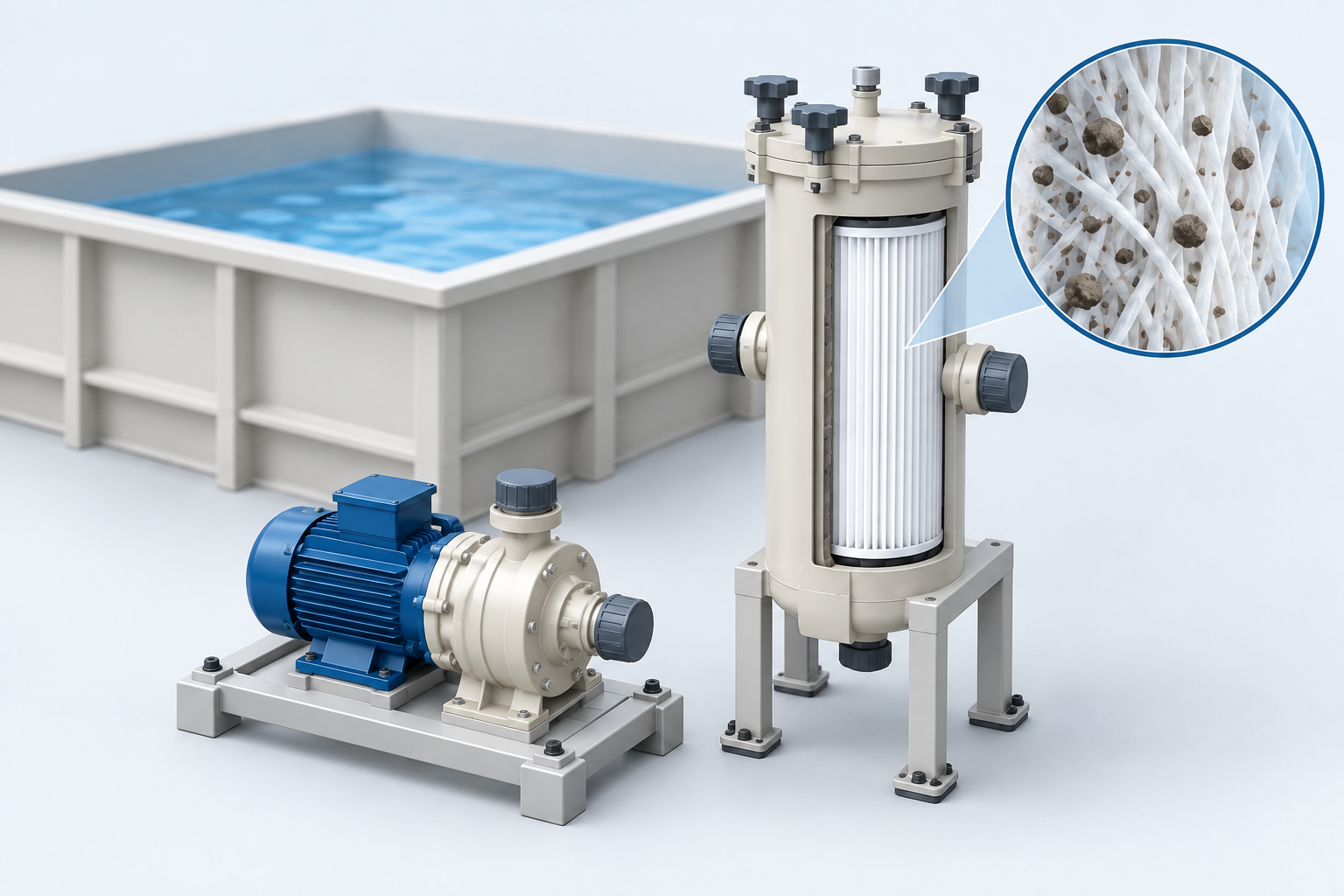
Filtration is often specified too late in an electroplating project. A buyer may ask for a filter with a familiar micron number, while the real production concern is a mixture of suspended particles, dissolved contamination, media compatibility, pump behavior, and the time needed to service the unit. Treating all of these as one number can produce a system that looks correct on a datasheet but is difficult to operate on the floor.
For an equipment project, the more useful question is: what must be controlled, at what operating point, and how will the operator verify and service it? The following framework helps a procurement or engineering team turn that question into a practical filtration brief for a plating line.
Start by separating particles from dissolved contamination
Suspended particles are solid material carried by the bath. They may come from handling, corrosion, precipitates, degraded media, or work entering the tank. A physical filter can retain a portion of this load when the filter media, housing, flow path, and loading condition are correctly selected.
Dissolved contamination is different. A clear-looking solution can still contain dissolved metals, organic residues, or other species that are not removed simply because a filter has a smaller nominal opening. Some problems call for chemical control, bath analysis, or an adsorption step rather than tighter particle filtration. The specification should therefore identify whether the goal is particle removal, adsorption, or a separate bath-management action. A filter quotation should not silently turn one goal into another.
Specify media compatibility before choosing a micron value
Filter media and wetted parts must be considered against the actual bath chemistry, temperature, concentration, exposure duration, and cleaning practice. A material that is acceptable for one solution can behave differently in another. The same caution applies to seals, gaskets, hoses, pump components, and any adhesive or coating inside the flow path.
That is why a generic statement such as 5 microns or 10 microns is not a complete specification. The number describes one characteristic of a medium; it does not confirm chemical compatibility, useful dirt-holding capacity, pressure behavior, or the quality result on a particular part mix. Ask the supplier to state which media and wetted materials are proposed, what information the selection is based on, and which conditions still require project confirmation.
Define the loaded-filter operating point
A filter that meets a clean-start flow rate may not maintain that flow after it collects solids. During selection, record the expected bath volume, circulation objective, pump curve or available differential pressure, likely contamination load, and the allowable pressure drop. A useful brief distinguishes clean-filter flow from loaded-filter flow and explains how the operator will know that the service point has been reached.
Pressure monitoring is part of this decision. A gauge or differential indication can show a rising restriction trend, but the alarm or change-out point should be established for the selected housing, media, pump, and process. Do not copy a universal micron number, turnover target, or pressure limit from another line. Those values may not represent the same chemistry, tank volume, part loading, or pump arrangement. If the process requires a particular circulation rate, state it as a design assumption to be checked rather than as an unconditional promise.
Design service access as an operating requirement
Particle control is only useful when the filter can be inspected and maintained without turning a routine service task into an improvised shutdown. The layout should show isolation points, drain or containment provisions, venting where applicable, and a safe route for removing a loaded bag, cartridge, or other media. The service side needs enough clearance for the actual component, not only the footprint shown in a plan view.
Ask where the operator will read pressure, how a filter is isolated from the bath, where residual liquid goes, and how the used media is handled under the site’s own waste procedures. Check whether pumps, valves, and seals can be reached while adjacent equipment remains in place. A compact arrangement may save floor area but cost more in maintenance time if a housing door cannot be opened or a component cannot be lifted safely.
A procurement checklist that survives design review
| Specification item | What to document |
|---|---|
| Contamination objective | Suspended particles, dissolved species, adsorption need, or a combination with separate stages. |
| Bath conditions | Known chemistry, concentration range, operating temperature, exposure duration, and cleaning method. |
| Media and wetted materials | Proposed grades, seals, gaskets, hoses, housing materials, and the basis for compatibility review. |
| Flow and pressure | Required circulation assumption, clean and loaded flow, pump arrangement, pressure monitoring, and service criterion. |
| Access and containment | Isolation, drain path, clearance, lifting or handling method, and operator inspection points. |
Use the equipment discussion to close the unknowns
Before requesting a final configuration, collect the bath list, tank information, part and rack loading pattern, available utilities, and the site’s maintenance constraints. If any of these are unknown, mark the item as an engineering assumption. This makes later changes visible and avoids presenting a preliminary filter selection as a guaranteed result.
For a filtration review, bring the bath list, expected contamination, proposed media constraints, pump information, and service-clearance drawing to a discussion with Raymond (Changzhou) Equipment Co., Ltd. The Raymond equipment solutions and copper plating line pages provide project context; final media, flow, pressure and compatibility decisions still require chemistry-specific confirmation.